
How to Trade Gold (XAU/USD) CFDs
A practical, step-by-step guide to trading gold CFDs with FxPro. Learn contract sizes, margin, risk sizing, costs and trade management before you place your first order.
What is gold and how does a gold CFD work?
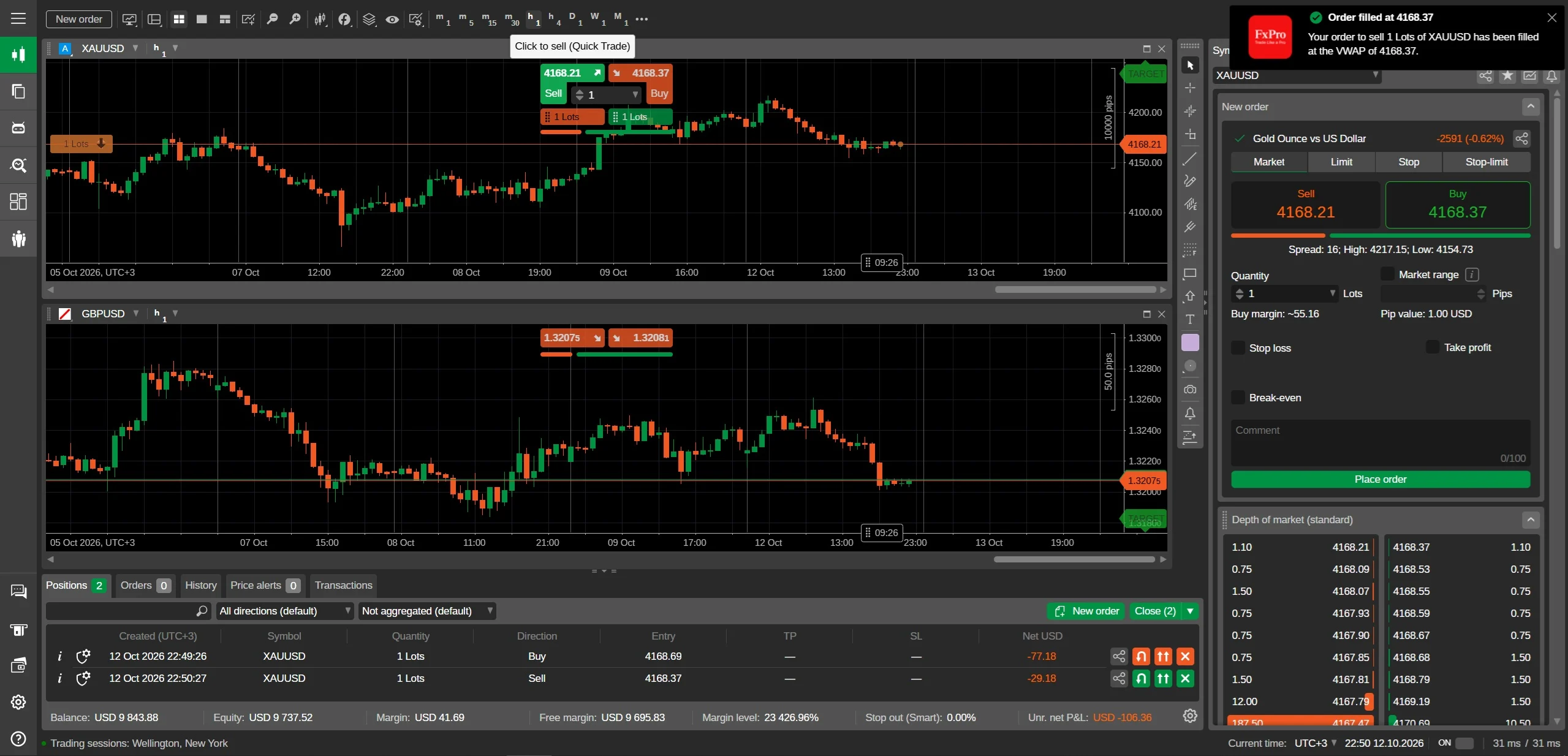
Gold is traded as a CFD on the spot price of XAU/USD, meaning you speculate on price movements without owning physical bullion. A CFD lets you go long or short with leverage, profiting from both rising and falling markets.
With FxPro, you trade gold on MT4, MT5, cTrader or the FxPro app. The price is quoted in US dollars per troy ounce, so your profit or loss is realised in USD and converted to AUD by your broker when you withdraw.
Lots and contract size for gold
One standard lot of gold (XAU/USD) equals 100 troy ounces. A movement of 0.01 in the price is one pip, worth US$1 per standard lot. If gold moves from 4275.0 to 4275.5, that is a 50-pip move, or US$50 on one lot.
You can trade smaller sizes: 0.10 lots is 10 ounces, where a 0.01 move is worth US$0.10. This flexibility is essential for risk management, especially when starting with a modest account.
Leverage and margin on gold
Leverage lets you control a larger position with less capital. The maximum leverage available in Australia for gold is up to 1:200, and at that leverage a 0.10-lot gold position requires about A$85.50 margin, based on a reference price of 4275.0. That is the amount locked by your broker while the trade is open.
Leverage magnifies both gains and losses. A 1% adverse move on 0.10 lots would lose roughly US$42.75, which is about half the margin. Always treat leverage as a tool to reduce margin, not to increase risk.
Sizing a gold trade to a fixed risk
The core discipline is risking a fixed percentage of your account per trade, typically 1–2%. First decide your stop-loss distance in pips, then calculate the position size so that if the stop is hit, you lose only that fixed amount.
For example, if your account is A$10,000 and you risk 1% (A$100), and your stop is 50 pips away, then each pip must be worth A$2. In USD terms, that is about 0.20 lots (since 1 pip on 1 lot is US$1). Adjust for the AUD/USD rate.
The real cost of trading gold: spread and swap
The spread is the difference between the buy and sell price. FxPro offers the spread your account type carries on gold, but they widen during volatile news. The spread is a cost you pay on entry, so a 30-pip spread on a 50-pip target is significant.
If you hold a gold position overnight, you pay or receive a swap (financing) rate. Swaps are charged daily and can add up on long-term trades. Check FxPro’s current swap rates for gold before holding over the rollover time.
Placing a stop and managing the trade
Always place a stop-loss order when you enter a gold trade. A stop is a pre-set price that closes your position automatically to limit losses. For gold, common stop distances range from 20 to 100 pips depending on volatility.
Manage the trade by moving your stop to breakeven once the price moves in your favour by about the initial risk. Avoid widening stops; if the market hits your stop, accept the loss and look for the next setup. Never add to a losing position.
Common beginner mistakes on gold
The most frequent mistake is overleveraging: using maximum leverage to trade a size that wipes out the account on a small move. Gold can move 100 pips in minutes during news, so a 0.10-lot position with the maximum available leverage of 1:200 can lose the entire margin quickly.
Other mistakes include trading without a stop-loss, averaging down on losing trades, ignoring the spread cost, and holding overnight without checking swap rates. Beginners also overtrade, trying to catch every move instead of waiting for high-probability setups.
A realistic first gold trade walk-through
Suppose you have A$5,000 and decide to risk 1% (A$50) on your first gold trade. You see a breakout at 4275.0 and place a buy stop at 4276.0 with a stop-loss at 4271.0 (50 pips risk). Your target is 4286.0 (100 pips).
Using the formula, with a 50-pip stop and A$50 risk, each pip must be worth A$1. That is about 0.07 lots. You place the order on MT4 with a stop and target, then let it play out. If stopped, you lose A$50; if target hit, you gain A$100. This is a controlled trade.
Your first week on a demo: test execution, not just direction
In your first week on a demo account, you should test how order execution behaves around your own entries and stops, not chase a winning streak. Open a free FxPro demo, set the balance to a realistic A$5,000, and place at least 20 gold trades of 0.10 lots or less. The goal is to see where market orders fill relative to the price you clicked, how far price moves against you before a stop triggers, and whether you hesitate when a trade goes red. Those observations tell you more about your future live results than any single profit or loss.
A demo week should include one full London and one full New York session on XAU/USD, because gold spreads and volatility change with liquidity. Note the average spread you see at 10:00 Sydney time versus 22:00 Sydney time; you will notice it widens when London closes. Also test a guaranteed stop order if FxPro offers it on your demo account, and compare the fill to a normal stop on the same setup. This teaches you the cost of protection before you ever risk real money.
Finally, use the demo to rehearse your rules for cutting a trade when it is wrong. Set a rule such as: if price closes beyond my stop distance within 15 minutes, I close the trade manually and wait one hour. Practise that on demo until it feels boring. The first week is not about finding a magic strategy; it is about proving you can follow a process when the chart moves against you. If you cannot do it on demo, you will not do it with A$100 on the line.
Keeping a trade journal that reveals your actual edge
A useful trade journal records five fixed fields before you enter: date and session, setup name, entry price, stop price, and position size in lots. For gold, also write the ATR value or the dollar distance from entry to stop, because that distance determines your risk. Do not write a story about why you think gold will go up; write the observable trigger, such as: price broke the Asian range high at 4278.5 with a 15-minute close above it. This forces you to name your edge instead of trading a feeling.
After the trade closes, record the exit price, the profit or loss in A$, and the R-multiple: the result divided by the amount you risked. If you risked A$50 and made A$75, that is 1.5R. Also write one sentence on execution quality: did the stop slip, did you move the stop, did you exit early? Over 30 trades, those R-multiples and execution notes show whether your wins come from the setup or from lucky timing. Most beginners find their average loser is bigger than planned, and that is the first fix.
Review the journal once a week with a specific question: if I had taken every A+ setup and skipped every C setup, would my R total improve? Count the trades by setup type, not by profit. A journal is not a diary; it is a performance record. Write in it immediately after you close the trade, not at the end of the day. For gold, include the session because your edge may only work in London or New York. After 50 logged trades, you will know whether you have a real edge or just a good month.
Position sizing as a habit: fix the risk, not the lots
The habit is to decide your dollar risk first, then calculate lots, every single time. Pick a fixed amount you are willing to lose on any one gold trade, such as A$50 or 1% of a A$5,000 account. Before you look at the chart, write that number down. Then measure the stop distance in pips or dollars from your entry. If your stop is $4.00 away on XAU/USD, and one lot moves $100 per $1.00, then your position size is risk divided by stop distance divided by $100. For A$50 risk and a $4.00 stop, that is 0.125 lots, or roughly 0.12 lots.
Make the calculation automatic by using a spreadsheet or a simple formula on your phone. Do not rely on the platform's margin indicator, because margin is not risk. At the maximum leverage available in Australia of 1:200, a 0.10-lot gold position needs about $85.50 margin, which can tempt you to trade 1.00 lot because the margin is still low. That is the trap: margin lets you open the trade, but only your stop and position size decide how much you lose. Fix the risk first, and the lot size becomes a consequence, not a choice.
To turn this into a habit, set a rule: if the stop distance would make the position smaller than 0.01 lots, you skip the trade. That means your stop is too wide for your risk budget, and chasing it with a bigger lot size is how accounts blow up. Also cap your total risk across all open gold trades at 2% of your account. If you have two trades at 1% each, you do not open a third. This habit removes the emotional negotiation that happens when a setup looks 'too good' to keep small.
The three most expensive beginner mistakes and the rules that prevent them
The most expensive beginner mistake is moving a stop loss further away to avoid being stopped out. The rule that prevents it: set your stop before you enter, write it in your journal, and never move it except to lock in profit after price moves at least one full risk unit in your favour. On gold, a $3.00 stop moved to $6.00 doubles your dollar risk without changing the trade's probability. If you cannot accept the original loss, your position is too big, not your stop too tight.
The second most expensive mistake is adding to a losing position, often called averaging down. The rule: you may add to a position only if the second entry meets the exact same setup criteria as the first, and the combined risk still fits your fixed dollar risk. For example, if your first 0.10-lot trade risks A$40 and gold drops $2.00, adding another 0.10 lots at the lower price doubles your exposure and often doubles your loss. Averaging down on gold is how a A$200 account becomes A$50 in one afternoon.
The third most expensive mistake is trading gold during rollover or major news without knowing the swap and spread impact. The rule: check the economic calendar before every trade, and never open a new gold position within 15 minutes of high-impact US data such as CPI or non-farm payrolls. Also check the swap rate on your platform for holding XAU/USD overnight; on a Wednesday, triple swap applies. A trade that looks profitable can lose its entire gain to spread widening and swap if you hold through the wrong hour. Know the cost before you click.
The first week on a demo: test execution, not just direction
Your first week on a demo account is for testing execution quality and platform mechanics, not for judging whether you can predict gold’s direction. Open a demo with FxPro on MT4, MT5 or cTrader and place at least 20 market orders on XAU/USD during active hours, noting how quickly each fills and whether the price you tapped is the price you got. Also test a limit order above the market and a stop order below it, then deliberately move your stop on an open trade to see the margin impact in real time.
The most useful thing to test in that first week is how the platform behaves when you are wrong, not when you are right. Set a 0.10-lot trade with a 100-pip stop and then trigger the stop by price action; confirm the loss is exactly what your formula said it would be. Then do the same with a take-profit. Use the FxPro app to modify a trade while away from your desk, because mobile execution is often slower and you need to know that before real money is involved.
A demo week should also reveal whether your internet and device setup can handle fast gold moves without requotes or frozen charts. Place a 1.00-lot trade on a demo and watch the P/L tick during a high-impact news event such as US CPI; that is when execution risk appears. If you see slippage or a delay, it is not a reason to abandon the broker, but it is information. Write down the worst delay you observe so you can compare it later when you test a live account with a small deposit.
See FxPro in action
FxPro gives Australian traders MT4, MT5, cTrader, and its own app. Australian traders can fund via PayID or bank transfer and start with a low entry.
See FxPro trading conditions →